In today’s competitive pharmaceutical landscape, sales representatives face an increasingly complex challenge: determining the optimal way to engage with healthcare providers (HCPs) to maximize prescription outcomes. With hundreds of potential customers, multiple interaction channels, and limited time, making the right decision about who to contact, when, and how can mean the difference between meeting sales targets and falling short. Enter the Next Best Action (NBA) recommender, an AI-powered solution that’s transforming how pharmaceutical sales teams prioritize and execute their outreach strategies.
The Challenge: Information Overload in Pharmaceutical Sales
Interactions and sales generate data that sales representatives must synthesize to guide their next steps. Traditional approaches often rely on intuition, basic CRM alerts, or simple rules like “contact anyone you haven’t spoken to in 30 days.” These methods fail to capture the nuanced patterns that truly drive prescription behavior. They can’t answer critical questions like:
- Which interaction type will be most effective for a specific HCP at this moment?
- How does the timing between interactions impact prescription likelihood?
- What sequence of touchpoints historically leads to the best outcomes?
- Which HCPs are most likely to respond positively to outreach right now?
Using XGBoost for NBA Recommendations
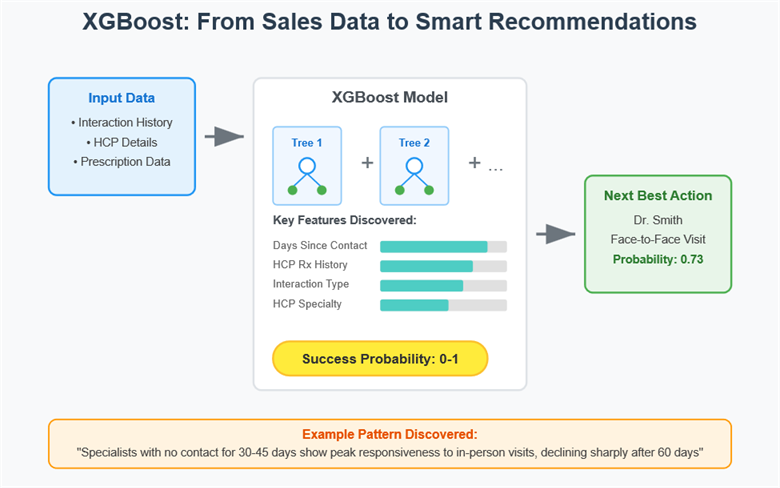
Modern NBA recommenders leverage machine learning algorithms to identify patterns in complex sales data, and XGBoost (eXtreme Gradient Boosting) is one possible algorithm. Originally developed in academia, it’s now widely used across industries for its balance of performance and interpretability. The algorithm works by building a series of decision trees, where each new tree learns from the mistakes of the previous ones. This iterative process creates a robust model that can identify subtle patterns in sales and prescription data.
What makes this approach particularly well-suited for pharmaceutical sales? First, it handles the mixed data types common in this domain: categorical variables like interaction types and numerical features like days since last contact. Second, it provides transparency through feature importance scores, helping sales teams understand which factors drive recommendations. Finally, it’s fast enough for real-time scoring while being sophisticated enough to capture complex interaction patterns.
Key Considerations for Implementation
While the potential of NBA recommenders is substantial, successful implementation requires careful consideration of several factors:
Data Quality and Integration The model is only as good as the data it’s trained on. Organizations need clean, consolidated data from CRM systems, prescription databases, and other sources. This often means addressing years of inconsistent data entry and integrating disparate systems.
Change Management Sales representatives need to trust and adopt the recommendations. This requires transparency in how recommendations are generated and proof of their effectiveness. Starting with pilot programs and sharing early wins helps build organizational buy-in.
Regulatory Compliance All recommendations must align with pharmaceutical industry regulations regarding HCP interactions and data privacy requirements. The system needs to respect interaction limits and ensure all suggested actions comply with company policies.
Continuous Learning The best NBA systems continuously update their models as new data becomes available, adapting to changing market conditions and HCP preferences. This requires robust data pipelines and monitoring systems to ensure model performance doesn’t degrade over time.
Looking Ahead: The Future of Pharmaceutical Sales
As AI technology continues to advance, NBA recommenders will become even more sophisticated. Organizations are exploring various enhancements:
- Integration with real-time market data and competitive intelligence
- Multi-channel orchestration for coordinated marketing and sales efforts
- Advanced attribution models that better capture long-term relationship value
The key is choosing the right approach for your specific data and business constraints. What works for a large pharmaceutical company with millions of interactions might differ from what’s optimal for a specialty biotech firm.
Taking the Next Step
The pharmaceutical sales landscape is evolving rapidly, and organizations that embrace AI-powered decision support will have a significant competitive advantage. Whether through methods like XGBoost, deep learning, or other machine learning techniques, NBA recommenders represent a practical application of AI that can deliver immediate value.
Is your sales organization ready to move beyond intuition and simple rules to truly data-driven decision making? Modern machine learning approaches can unlock insights hiding in your data, transforming how your team engages with healthcare providers and ultimately improving patient access to life-changing medications.